




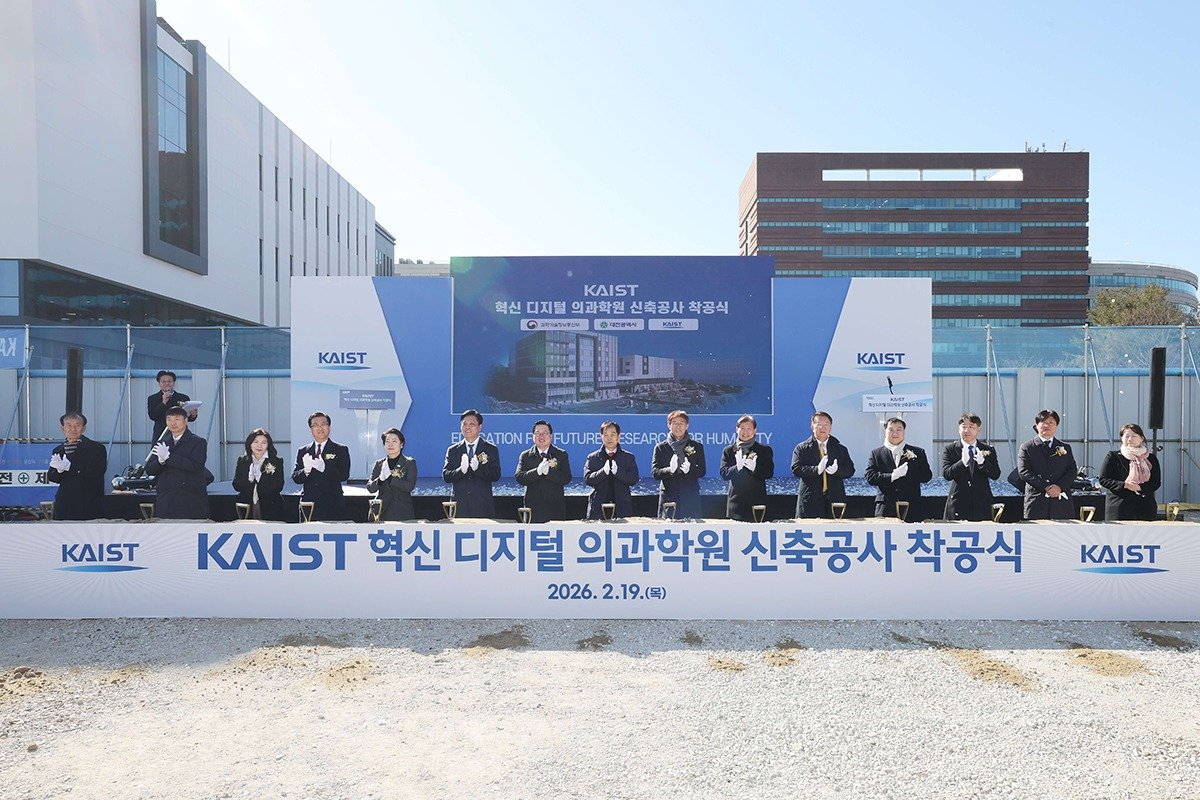
EduAsiaNews, Daejeon — The Korea Advanced Institute of Science and Technology (KAIST) has officially broken ground on the Innovative Digital Institute of Medical Science in a ceremony held at its Munji Campus, Yuseong-gu, Daejeon, on Thursday (19/2/2026). The new institute is designed as a strategic infrastructure to support South Korea’s ambitions to become a global leader in medical artificial intelligence (AI), the pharmaceutical industry, and the broader bio-health sector. Its construction marks a new chapter in the nation’s efforts to cultivate a generation of technologically fluent physician-scientists.
To be built on KAIST’s Munji Campus, the institute is a project aimed at nurturing core talent while building an innovation infrastructure and startup ecosystem. Its purpose is to advance Korea’s national development goal of “achieving excellence in medical AI, pharmaceuticals, and bio-health.” The central government, the City of Daejeon, and KAIST have jointly committed a total investment of 42.23 billion won (approximately USD 30 million) to construct a seven-story building with a total floor area of roughly 10,000 square meters. Construction is targeted for completion in November 2027.
The establishment of this institute is driven by deep concern over the state of research human resources in South Korea. To date, the proportion of Korean medical school graduates who choose a career as a physician-scientist or medical engineer remains below one percent — far behind other advanced nations. This gap is seen as a growing threat to national competitiveness in the bio-health sector, which is expanding rapidly alongside global advances in AI and biotechnology.
Through this initiative, KAIST aims to expand its physician-scientist training capacity from approximately 20 individuals per year to between 50 and 70 per year — equivalent to meeting roughly 50 percent of the national demand.
The institute will be equipped with a range of cutting-edge research and support facilities, including an AI-Based Precision Medicine Platform Research Center, a Data-Driven Convergence Health R&D Center, an Advanced Biomedical Data Analysis Center, a Digital Medical Bio Open Lab, an Open Networking Hall, and dedicated seminar rooms.
KAIST President Lee Kwang-hyung affirmed that the construction of this institution represents the university’s long-term commitment to serving both national interests and humanity at large. “The KAIST Innovative Digital Institute of Medical Science will become a core base for the future AI-driven digital health industry,” he said. KAIST’s move is also in line with global trends, as leading science and technology universities in Hong Kong and Singapore have begun establishing medical schools built on the convergence of science, technology, and AI — a model that is increasingly becoming the benchmark for nations competing to win the bio-digital era. (**)
(Sources: KAIST News Center, Korea Biomedical Review, Seoul Economic Daily)