




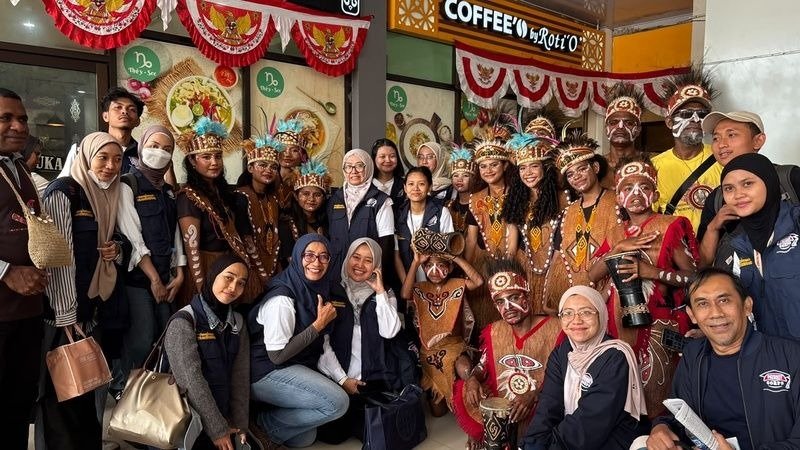
EduAsiaNews, Keerom – Universitas Diponegoro (UNDIP) has deployed 20 Patriot Expedition Teams, comprising 100 academics, to Keerom Regency, Papua Province. The deployment forms part of the university’s commitment to supporting the acceleration of regional development and the transformation of transmigration areas, particularly along the Indonesia–Papua New Guinea border.
The UNDIP Patriot Expedition Team arrived in Keerom Regency on Saturday, 1 August 2026, and was officially welcomed by the Keerom Regency Government at the Girgura Kensuwri Sports Hall, Workwana Village, Arso District. Over the next four months, the teams will conduct research, field studies, and community assistance programs. Activities will be concentrated in two border districts: Senggi District and Web District.
Keerom Deputy Regent Daud expressed his appreciation for UNDIP’s participation in supporting the development of transmigration areas in the region. According to him, the Patriot Expedition represents a strong synergy between the central government, local government, and higher education institutions.
“The presence of Universitas Diponegoro’s Patriot Expedition Team is a great honor and source of pride for both the Keerom Regency Government and its people,” Daud said.
He explained that the Keerom Regency Government fully supports this strategic initiative of the Ministry of Transmigration. Keerom possesses considerable development potential in sectors such as agriculture, plantations, natural resources, and the region’s rich social and cultural heritage.
“We hope the Patriot Expedition Team will help identify the region’s potential, introduce innovative approaches, and formulate recommendations that will benefit the local community,” he added.
The Keerom Regency Government also reaffirmed its commitment to supporting the program to help develop advanced, self-reliant, and sustainable transmigration areas. Community participation, he noted, will play a vital role in ensuring that the proposed programs and innovations are effectively implemented in accordance with local needs.
UNDIP Patriot Expedition 2026 Coordinator, Prof. Wiwandari Handayani, explained that this year’s expedition adopts a more application-oriented approach than previous programs. Rather than merely mapping regional potential and identifying challenges, the teams are tasked with developing practical solutions that can be directly tested and implemented in the field.
In line with the direction of the Minister of Transmigration, the second year of the program emphasizes the development and implementation of pilot solutions. Through this approach, research outcomes are expected to go beyond theoretical recommendations and evolve into practical models that deliver tangible benefits to local communities.
The involvement of academics from various disciplines is expected to strengthen local potential, improve community productivity, and support the integrated development of border regions. The teams will work closely with local governments and communities to ensure that every program is tailored to the social, economic, and geographical characteristics of Keerom Regency.
Through the Patriot Expedition, UNDIP reaffirms its commitment to leveraging knowledge, research, and innovation to address real-world challenges faced by society. The collaboration is expected to produce a sustainable model for transmigration area development that can continue to be implemented by local governments and communities after the expedition concludes.
The deployment of the UNDIP Patriot Expedition Team to Keerom Regency also demonstrates the university’s contribution to achieving the United Nations Sustainable Development Goals (SDGs), particularly SDG 1 (No Poverty), SDG 8 (Decent Work and Economic Growth), SDG 9 (Industry, Innovation and Infrastructure), SDG 10 (Reduced Inequalities), and SDG 17 (Partnerships for the Goals).
The program also reflects the spirit of “UNDIP Bermartabat, UNDIP Bermanfaat” (“UNDIP with Dignity, UNDIP for the Benefit of Society”) by strengthening the role of higher education in fostering productive, competitive, inclusive, and sustainable development in Indonesia’s border regions. (Public Communications / TEP)