


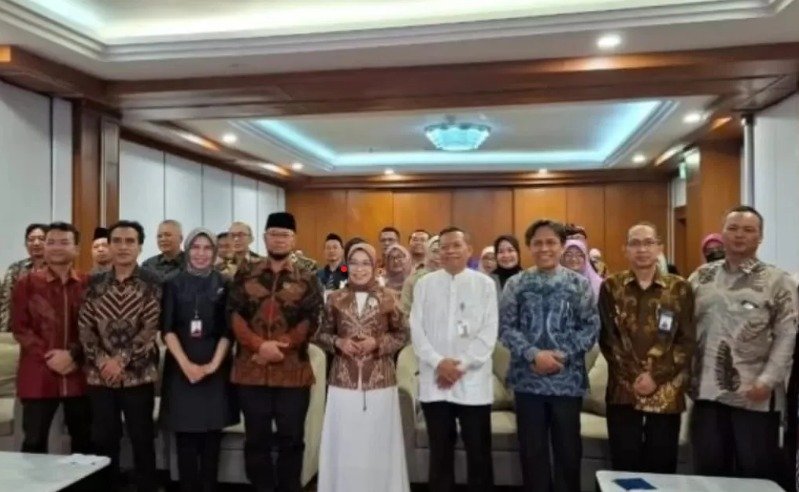
EduAsiaNews, Tangerang Selatan – Access to higher education for teachers is now increasingly open. The government, through the Ministry of Primary and Secondary Education (Kemendikdasmen), launched the 2026 Fulfillment of Academic Qualifications S-1/D-IV program as a concrete step to improve the quality of educators across Indonesia, supported by flexible learning systems from various universities, including Universitas Terbuka.
The program is implemented in collaboration with 113 Teacher Education Institutions (LPTK) and targets 17,930 teachers from early childhood education (PAUD) to senior high/vocational schools (SMA/SMK) nationwide. This initiative aligns with Law No. 14 of 2005 concerning Teachers and Lecturers, which mandates that teachers hold a minimum academic qualification of a Bachelor’s (S-1) or D-IV degree.
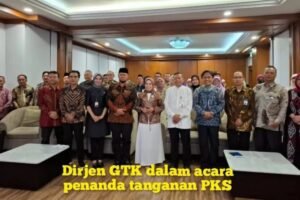
The Director-General of Teachers and Education Personnel (GTK), Nunuk Suryani, emphasized that enhancing teacher quality is key to advancing national education.
“This program not only meets regulatory requirements but also supports the realization of quality education for all. It ensures that teachers not only obtain the required qualifications but also enhance their competencies in delivering classroom instruction,” she stated in Jakarta.
The program is designed to address challenges teachers face, such as limited time and restricted access to higher education. Here, the role of Universitas Terbuka is crucial. Through its distance learning system, the university enables teachers to continue teaching while pursuing their studies without leaving their workplace.
The Rector of Universitas Terbuka, Ali Muktiyanto, affirmed the university’s readiness to provide an adaptive and easily accessible learning system. This approach allows teachers to study independently with the support of evolving digital technologies.
Universitas Terbuka also provides a solution for teachers in remote areas who have difficulty accessing conventional universities. Through open and distance learning, opportunities to earn a Bachelor’s degree are now more inclusive and equitable.
In addition to flexibility, the program includes a Recognition of Prior Learning (RPL) scheme. This allows teachers’ teaching experience to be recognized as semester credit units (SKS), making study duration more efficient.
The government also provides financial support of up to IDR 3 million per semester per participant, covering tuition and examination fees, enabling teachers to participate without financial burden.
Upon completing their S-1 or D-IV studies, teachers will have the opportunity to enroll in the Teacher Professional Education (PPG) program to obtain certification and professional allowances. This is expected to directly enhance classroom learning quality.
In summary, the program involves thousands of teachers (who), offers S-1/D-IV education (what), begins in 2026 (when), is implemented nationwide (where), aims to improve national education quality (why), and is delivered through flexible systems, RPL, and financial support (how).
More than a policy, this initiative marks a significant shift in access to higher education in Indonesia. Together with Universitas Terbuka, distance and time are no longer barriers. In line with SDG 4 on quality education, this program paves the way for teachers to continue learning, developing, and returning to the classroom with stronger competencies for the future of the nation’s generations.